Blog Archive

Sunday, 26 January 2014

Individual Analysis- X-men First Class

For this task I chose to look at the film X-Men First Class, one of the similar films to our own.

Trailer:

Plot (From imdb.com):
"In 1962, the United States government enlists the help of Mutants with superhuman abilities to stop a malicious dictator who is determined to start world war III."

Stars:
  • James McAvoy
  • Michael Fassbender
  • Kevin Bacon
  • Jennifer Lawrence
  • Nicholas Hoult
  • Lucas Till
  • Rose Byrne
  • Zoe Kravitz
  • Caleb Landry-Jones
  • Oliver Pratt
  • Jason Flemyng
  • Morgan Lily
  • Laurence Belcher
Details:
  • 20th Century fox
  • Action, Sci-fi and Adventure genres
Analysis:


The start of this film is a very standard one, going through the distributors logo and production companies starting with 20th Century Fox and moving through to Marvel who own the rights to the X-Men franchise.


From the Marvel logo it moves into an upwards tilt through a black screen, this then becomes a sort of wipe where the frame turns into a wall. This leads into an establishing shot, with a tagline of text which gives some context behind the scene. It is common knowledge that 1944 was the time of World War Two, and the fact that it is a dirty and dark scene means that a link to the Nazi concentration camps can be made due to the fact that it is set in Poland. The dark tone set by the dark lighting and colours as well as the rain shows the audience that this isn't going to be a pleasant scene.

This close up on the arm of one of the men shows a tattoo, which are fairly painful even when voluntary, shows numbers which has a strong connotation of a prisoner number. The rain in the background shows that he is at the place that we assume is the concentration camp, which this now backs up. He is standing in heavy rain with just a flimsy shirt on which shows just how badly he is being treated.

This high angle shot to look up at this particular character gives him a powerful status, he is inside away from the rain, looking down at the other people and simply watching them work in the pouring rain while he's in the comfort and safety of inside. Even though he is poorly lit, it can be seen that he is wearing an expensive looking suit which backs up that he is in high status, and he is drinking from some fine china which would not be cheap.


This next establishing shot with text to give context shows a much different scene from the one that we have just witnessed, set in the same year but in a different country altogether it shows a nice country mansion surrounded by green land and it looks like pleasant evening weather. The dark shows that it is nighttime in this scene, and all the lights but one room in the house are on which shows the audience that someone in the house is up, whether it be someone who lives in the house or someone who is visiting illegally.


This medium shot with a zoom out is showing the audience the powers which this young girl has, the blue skin that she has stands out against the plain colour scheme of the interior of the house. This makes the point that the girl is unusual, someone that is different and would possibly be scary because of how she could easily sneak around.


This two shot shows us the blue girl once again, but the way that she is clearly smaller than the boy shows her innocence and that she is not a danger even though she isn't something we see everyday. The way that the boy is extending a hand out to the girl shows that he is friendly and that this relationship is going to be important for the rest of the film.

The fact that every single character in this shot is in focus, gives the impression that even the ones that are placed at the back of the shot are important to the scene. The characters on the right side of the shot all have brown, dull looking clothes on which shows their lesser status to the man sat behind the desk with the posh suit. The fact he is holding a pistol which he is holding up to the weak looking woman in relation to the young boy is holding his arms out clearly attempting to use super powers but the pain on his face still seen though this wide shot shows that he is struggling.


These next two master shots show both sides of the young boys power, in both it is clear to see that with his arms raised he is putting a lot of force into his powers, and the pain that was expressed earlier when attempting to use his powers has now been replaced by anger. The first screen cap by only seeing the back of him and watching as all the metal objects flying around through the windows, makes him look powerful. Then the next screen cap from the perspective of the room where all the metal is flying around, it could possibly make the audience feel like they are in the middle of the metal storm, in a dangerous place and they're looking right at the anger on the young boys face. 


Because this scene is all spoken in German, reading the subtitles is important because it makes the whole thing even more believable. Linking the subtitle to the image of the man guiding the boy into the wrecked room, "You and me..." and the close proximity makes it appear that they are father/son rather than two strangers. The dark lighting and their silhouetted bodies gives off the sinister tone that is behind this relationship. 


The graphic match of the Nazi coin to the movie logo finally completes the title sequence and the silver on the black background gives it more of an official and serious look which sets the tone for the rest of the film.


When we get this close up of the arm, with a number tattoo similar to the one which we saw at the start of the show. From the way that the Nazi coin is seen hovering above his hand gives us a hint that this person is the same boy that we saw earlier on, just grown up.


This low angle shot gives the audience the first glance of the man's face, and the blank look he has on his face while concentrating on something off frame. The low angle on him links him back to the boy because its hinting at the fact that he's constantly oppressed. 


Once it has completely zoomed out to this wide shot, the date on the text shows that it is now 1962 which means that the war is over and the man on the bed very much is the little boy from the start of the movie but grown up. The props fit the 60's era furniture. What made him make the move from Poland/Germany to Geneva, Switzerland?


The close up on the pencil drawing means that the audience can recognise that the man in the picture is the same one from the start of the movie, and although at this point the audience don't know it the coin in the middle of the head is a very significant image. It is foreshadowing what is going to happen to this man by the end of the film, by the man on the bed who fired the coin at the wall with his super powers. This shows us a line of sight, as this is what he was concentrating on in earlier shots, and the fact that he's done this to a picture of the man shows great anger towards him.


As we now have the context of the leap in years, by the close up on this particular character we can assume that this man is the other young boy that we were introduced to at the start of the movie, and he is physically demonstrating his power here, by placing his fingers against his forehead. Certainly hinting that his power is mind related. His hair look neat and done well, which matches with the nice suit he is wearing which shows that he is much better off which makes sense if he grew up in a mansion.


When it comes to the first shot, it is a two shot but it is framed in a way that the blonde girl sat at one of the tables at the back of the pub is perfectly in shot even if she is out of focus. This means that she is going to be an important character, the fact that she is a girl could mean that she is the little girl who has the blue skin. She has the power of disguise, which means this could be the form she wears now she's older. In the second shot we see her moving into focus as she walks towards the two at the front which shows that she is in fact important.


Individual Analysis of Star Trek: Into Darkness

For this task, I chose to look at 'Star Trek: Into Darkness' as a similar film to the one we are creating. 

Trailer:


Additional Information:


Analysis:


In the first minute before the opening scene, the logo's of the above production companies are played, along with the movies soundtrack, showing and advertising those involved in the production of the Star Trek Movie.


The movie then begins with a clear establishment of the location, which is helpful to the audience as this happens to be a completely new and unheard or planet. Fading from the final logo, an establishing shot, along with text stating the whereabouts of the scene, shows unusual scenery, and then quickly zooms into a figure, then to a tribe of an unknown species closely following them. The camera then moves back to the previous figure, showing him fleeing into the red forest away from the tribe, suggesting a dispute between the two. The bright, vibrant colours give the audience the impression that this planet is pleasant and the dark costume of the figure being chased suggests they are indeed dark and unpleasant, however these impressions are used to subvert stereotype and create a small sense of shock factor as we see later on in the opening scene.


The chase is then continued, and followed through a range of tracking shots, showing the tribe's violent actions towards this unknown figure. The fast pace is exaggerated by the passing of the trees, as when the camera follows the figure, trees obstruct his path, and therefore the cameras.


When confronted by a monstrous beast, the yet-to-be-identified pulls out a high-tech stunning device and shoots it without hesitation, and a close up of the gun shows the audience a clear shot of the weapon being used, despite the quick paced scenes before. By doing so, the scenes previous sense of urgency is still conveyed through fast shots, yet the audience are still able to see what is going on within the madness.


Once the beast is stunned, it reveals yet another character dressed similarly to the first. This newly introduced character states that the gun is not set to kill, and in doing so, both figures reveal themselves to be Captain Kirk and Bones, two members of the USS Enterprise. For anyone who has seen the previous movie, they will instantly recognise the two characters, however if members of the audience have not seen the first movie, the fact that the gun is set to stun rather than kill will inform them that they mean no harm. The following conversation between these two characters goes into further detail about why they are on this planet, stating they are in fact trying to help the inhabitants.


A close up of the tribe chasing the two confirm that they are another species, and the use of a different language suggests a misunderstanding between both the tribe and Kirk and Bones, due to this language barrier.


Following a couple more shots of the chase scene, the camera films up to a volcano spewing smoke, with what seems to be a crane shot, making an easy transition into a smoky background for a space shuttle to fly through. This indicates a change of location, but as the intense soundtrack still plays over the transition, it informs the audience that this is still the planet, and same problem.


To show the audience that the characters being chased by the foreign tribe and the crew members aboard the space ship are on the same mission, Captain Kirk and Spock communicate back and forth, explaining their situations both on the planet and in the shuttle. This communication also informs the audience of what the previous events have happened for, and why the following events are relevant.


When Spock jumps from the ship in order to help the two members stranded, a tilt shot follows him as he jumps from the ship, as he passes and where he is falling to. This shows the audience the extent to which Spock is willing to fall in order to help Kirk and Bones, as well as his bravery.


A close up of Spocks face shows his sceptical expression, and following this with a shot from his POV gives an explanation to his emotion. Showing the audience where Spock is falling to informs them that although it was Spocks decision to make this jump, it is still a dangerous and terrifying journey to make. This can also allow the audience to imagine themselves falling to such a location, and the terror they would feel.


As Spock falls, more scenes from the shuttle shows malfunctions aboard the their escape vehicle, including a close up of an alert telling them that their engines are overheated. The red alert instantly gives the audience a sense of danger and urgency, increasing the tension of the overall situation.


Despite the crews opposition towards Spock's choice of action, Spock takes an uncomfortable landing within the opening of the volcano, and the danger of his situation appears to have increased yet again. As he regains stability, the camera takes an establishing shot of what surrounds Spock, showing his figure amongst lava and molten rock. By showing the audience Spock location relevant to this location, the audience can see the extent of danger.


Research into Title Sequences

What is the purpose of a
Title Sequence?

Films use title sequences to do a number of jobs, that vary depending on the genre of the film. These jobs may include:
  • Showcase the cast and crew involved in the production of their film. Although most of the crew tend to be mentioned during the end credits, the director, the producer, the executive producer, and the top billing actors are given separate recognition, along with the movie title
  • Show the logo and name of institutions involved in the Production, Distribution and Finance. By doing this, not only do the companies gain advertisement, but the audience are given idea as to what genre the film might be, as well as the production value to expect.
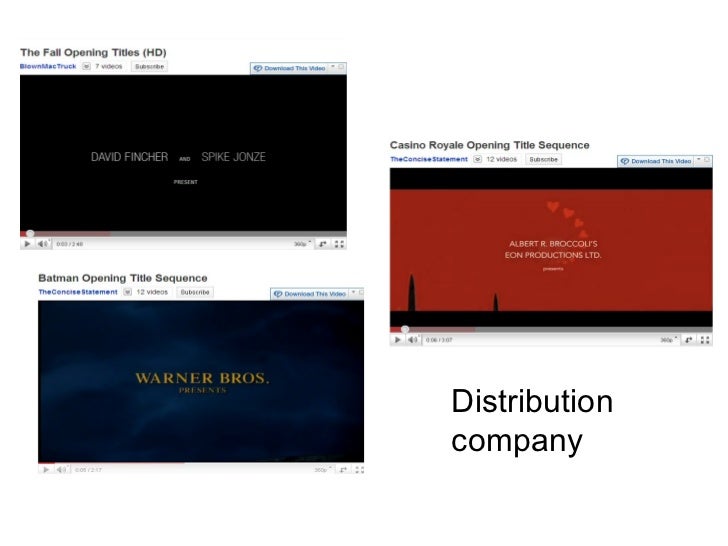
  • Give the audience an idea of what genre the film may be through colour scheme, music, camera effects and even the font of the text.
  • Give brief introductions to the main characters.
  • Give some background information/extra information.


Similar Films

X-Men First Class:


Due to the strong element of 'mutants' with super abilities throughout the film and throughout the whole franchise this is a very strong link to our own film.


Captain America:


The fact that the main character, Steve Rodgers, is genetically changed and that is how he gains his powers something which is very similar what happens to the main character of our own film.


The Amazing Spider-Man

The way that Peter Parker is bitten by a radioactive, genetically changed, spider and that is how he gains his powers is very similar to our own film.


Thursday, 23 January 2014

Distributors

The distributors that we looked at would all work for our movie because they are responsible for distributing the similar films that we have selected. Although the majority of them are mainstream that worked the best for us, I did find one independent distributor that I felt would also work well for our movie based on the main genres of Science Fiction and Action.

Paramount Pictures (mainstream):


Paramount were responsible for Thor, Avengers, Iron Man 3 and the reboot of the Star Trek franchise. All of these we classed as our similar films which is why we think Paramount would suit, even though they do have some movies which are very different from our own, like animated movie Rango.

20th Century Fox (mainstream):

The X-Men franchise, Star Wars and Planet of the Apes are all from 20th Century Fox. We felt that the X-Men movies were very similar to our own film which means that this distributor would be a really good choice for our own. 20th century Fox is also responsible for animated films like Rio and Epic, but overall the majority suits us.
Picture House entertainment (Independent):

It is hard to find an independent company that totally fits our film, but after looking at Picture House I think that it would suit it well enough. Other movies which are similar enough to our own with 'A field in England' having a war theme and 'The Impostor' having a more sinister feel which our own film will need with it having a 15 rating.


Analysis of a Similar Opening Sequence

Battle: Los Angeles

                           
The film opens by zooming out to a clip showing the name of a production and distribution company- Columbia Pictures (0:00-0:16). It the shows the name of another production company- Original Film (0:21-0:30). It then quickly cuts to black. At 0:33, the date August 12, 2011 the appears in the bottom left hand corner. This tells the audience when the film is set and allows them to get some sort of context before they see and action. The first action that the audience sees (at 0:35) is a shot of a warzone filmed with a green filter, which gives the effect of night vision goggles, and is either a point of view shot or hand-held. This gives the audience the impression that they are a part of the action and pulls them into the film from the very beginning. (0:36) Explosions are seen in the sky and people are seen running in the streets, which creates a sense of panic. The cuts are quick, which increases the pace, and it shows that the threat is violent and everywhere. The scene then moves to a news report from Los Angeles with a Sergeant Major who is talking about the situation (0:48). The lighting for this section has low saturation, which gives the effect of the news being dark and sad. This dialogue turns into a voice over which overlays more footage of people running and explosions. This then moves to a scene in a military base (0:56), which shows people gathering around a television screen watching the same news report as seen earlier. (1:09) There is a shot of people running which has an effect to make the picture move as though there is static affecting it like it would on a TV. This makes the audience feel as though this could actually be a real news story that they are watching. There are close ups on soldiers' faces (1:12) to show their scared facial expressions. (1:14) There is a medium close up show of a soldier on a computer rubbing his head, which shows the stress and the pressure of the situation.

Wednesday, 22 January 2014

Research into title sequences

Conventions of a title sequence
An opening title sequence to a film usually includes the following names:
-the name of the production company
-the name of the distribution company
-the director
-the producer
-the top billing actors
-the executive producer
-the movie title


Also, the opening title sequence will come after a short scene, which either;
-sets the scene
-briefly introduces the characters
-takes place half way through a situation to pull the audience in immediately
-narrates the story so far
-gives the audience an idea of the films genre
-sets the tone for the film
-presents the audience with a mystery that the protagonist will solve or be a part of

Examples of appropriate title sequences for our film
The Avengers
Even though this is an end credit it would still work as a title sequence for a film.

Star Trek: Into Darkness


Battle: Los Angeles


Captain America